Description and Requirements.
Patch360 enables you to import 3rd party applications into your Workspace. It currently supports applications sourced from the following public repositories, but hosted on our infrastructure:
- Microsoft Winget
It hosts multiple versions of each application.
The database is synced with public repositories on a daily basis.
The following is required to use it:
- An active Rimo3 Workspace
- A valid license that includes access
- Valid credentials

Accessing
It can be accessed directly from the Workspace user interface.
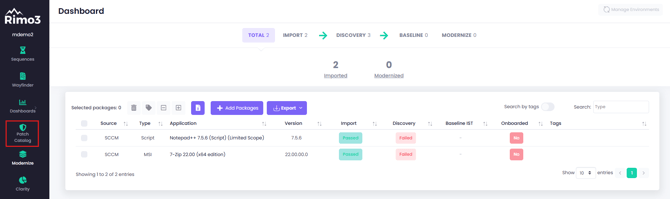
This will open Patch360 on a new tab in your browser and automatically log you in with Seamless Single Sign-On and preselect the workspace.
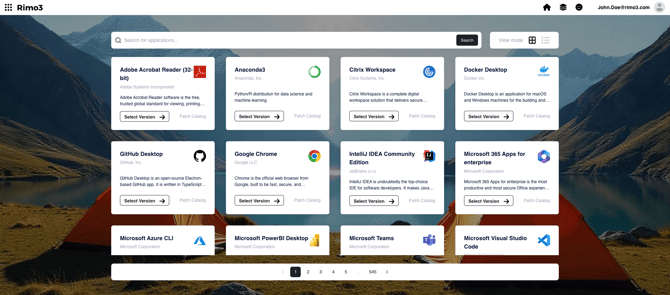
From here you can either:
- Search for an application directly from the search bar, or
- Scroll down and browse the catalog
You can browse the catalogue in grid format or list format by selecting the relevant option:

Importing an Application
One-time onboarding vs subscription
You can onboard applications in two ways:
-
One-time onboarding: Onboard a specific version once. Future versions are not imported automatically.
-
Subscription (auto-update): Subscribe to a configuration so that future versions are automatically onboarded using the selected pipeline.
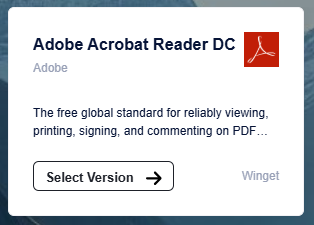
To import an application to Workspace, locate the application and then click on the <select version> button.
You will then be presented with all the available versions of that application.
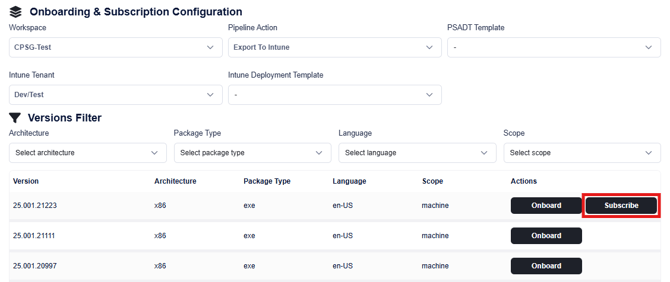
For a specific configuration, you can Subscribe only to the latest version of the application.
If needed, choose which workspace to import the selected application into.
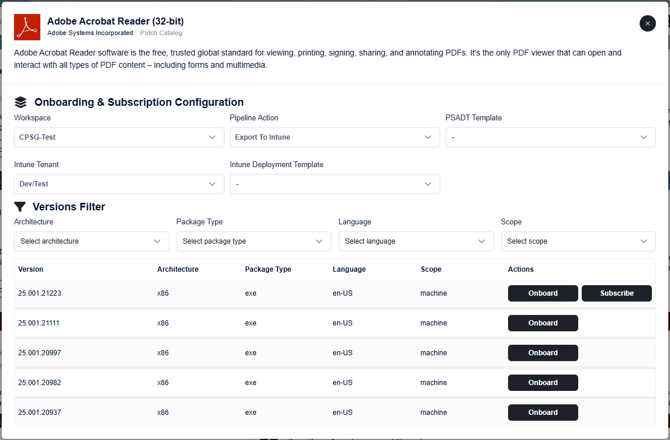
If the selected workspace has an Intune instance configured the pipeline action will automatically be set to Export to Intune.
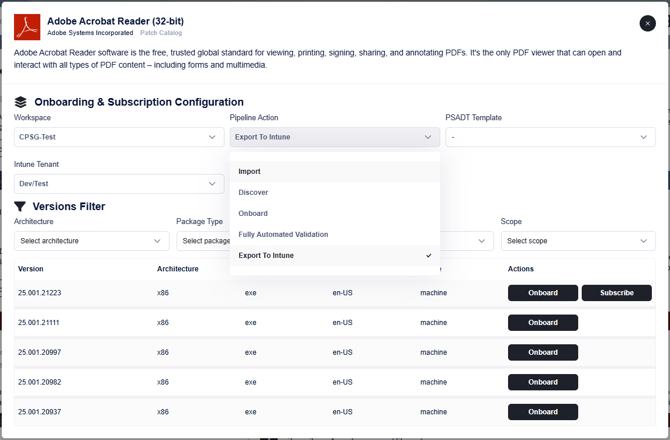
You can choose the level of automation that applies to the import process:
- Import - Only import the application
- Discover - Import and then Discover that application
- Onboard - Fully onboard the application only
- Fully Automated Validation - Onboard and validate the application against target environments.
- Export to Intune - Export the application to Intune if it passes all automated tests.
Export to Intune is only available if you have at least 1 Intune instance configured in your Rimo3 Workspace.
If you have multiple Intune tenants connected to your Rimo3 Workspace, your default Intune tenant will be preselected. You can expand the Intune Tenant drop-down menu to select a different one.
To configure a default Intune tenant follow the instruction here.
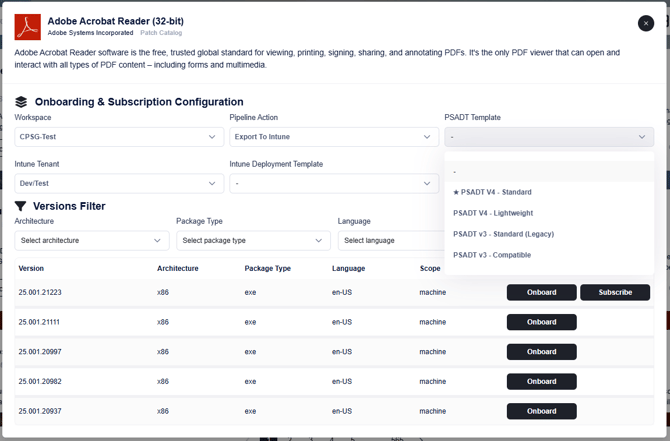
If you don't see a PSADT template dropdown then it is likely that PSADT wrapping is not enabled for the selected workspace. If this is the case, you can contact your Rimo3 account manager or e-mail technicalsupport@rimo3.com to get the feature enabled.
You can subscribe to the same configuration of an application multiple times with different PSADT templates if necessary. A separate subscription will be created for each PSADT template selected.
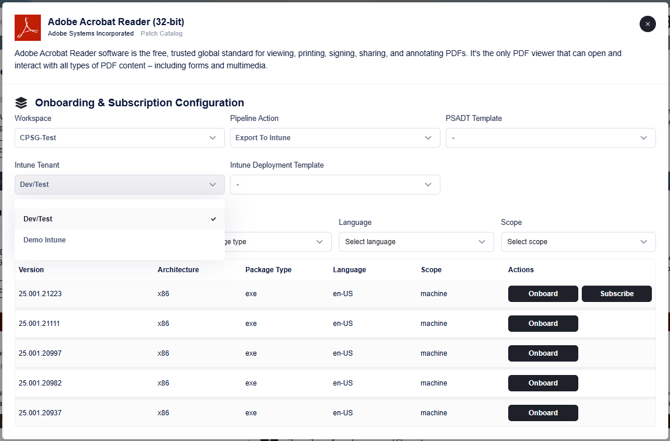
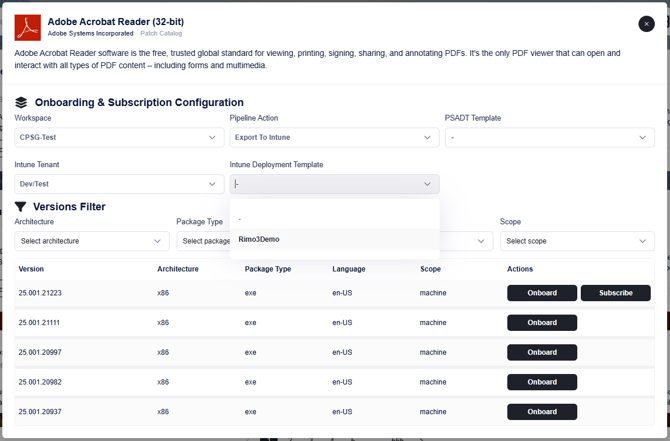
For more information on creating Intune Deployment Templates click here.

One-time onboarding of an application (specific version)
To onboard an application version one-time, find your desired application version and click on the Onboard button.
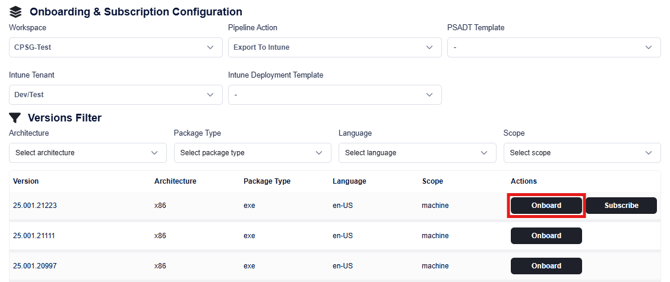
You can use the filters to find a specific Architecture, Package Type, Language or Scope (user/machine install)
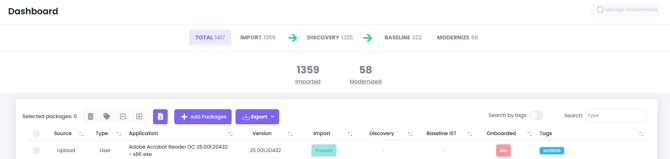
If the onboarding is successful, you will receive a confirmation message. Click on the provided link to track the progress, or simply navigate to the Overview dashboard to view the progress of the import.

If you receive an error when trying to onboard an application from the Patch Catalog, check the following:
- Your Change360 Gateway VM is online
- You have Task Runner environments configured
If all is well, and depending on what pipeline option you selected, you will see the application progressing on the Overview Dashboard.
Subscribing to an application (auto-update)
To onboard a specific version of an application and validate it with the pipeline of your choice, click on the Subscribe button instead.
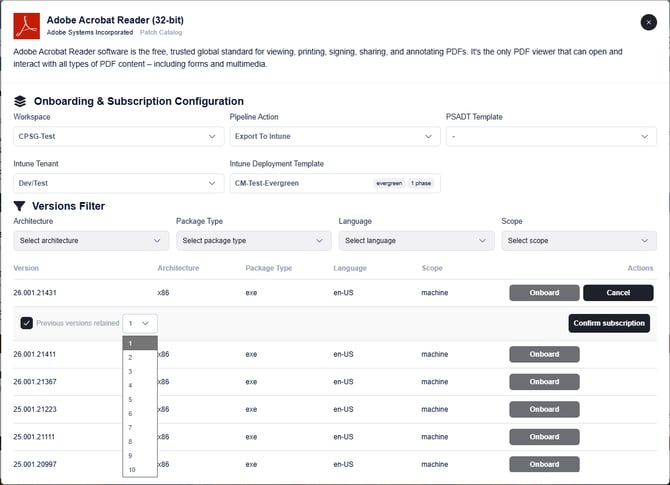
When subscribing to an application with an Evergreen Intune Deployment Template you can choose how many previous versions of the application to retain in Intune and your Change360 workspace. Once the threshold is reached older versions, created by the subscription, are automatically removed from Intune and your Change360 workspace.
If onboarding is successful, you will receive a message confirming your subscription to the application. Click the provided link to track progress, or simply navigate to the Overview dashboard to view the import's progress.

When subscribing to an application, newer versions of the application with the same architecture, package type, language, and scope will be automatically imported with the pipeline you've selected when subscribed.
To automatically import different architectures, package types, languages and scopes you will need to subscribe to each unique combination of properties.
Unsubscribing from an application
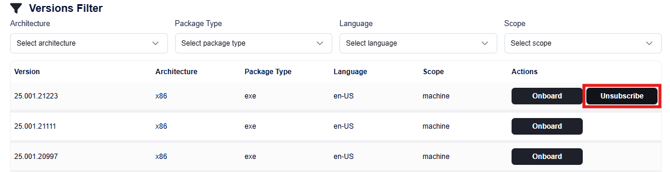
You can unsubscribe from a specific version and configuration at any time.
-
By unsubscribing, you opt out of onboarding new versions of the application.
-
Already onboarded versions are not removed.
Subscription Management
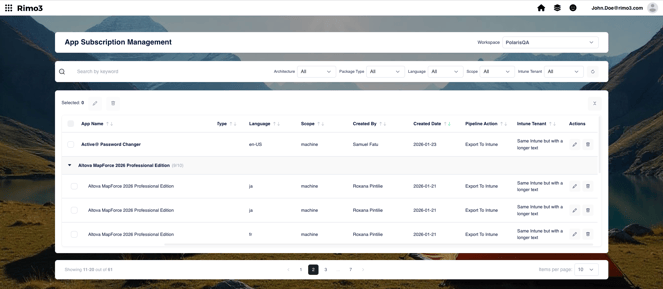
All users with access to Patch360 can manage their subscriptions from the Subscriptions Management page:
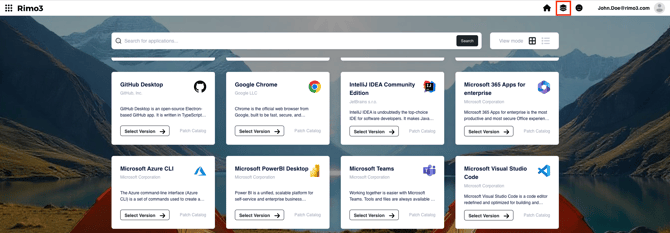
The App Subscription Management page lets you:
-
View your active subscriptions: see all applications and versions you have subscribed to (auto-update), per configuration.
- If you have multiple subscriptions, you can search and filter them.
- Manage subscriptions:
- Edit subscriptions: You can edit a subscription by changing the validation pipeline, PSADT Template and the Intune Tenant. Subscriptions can be edited individually or in bulk from the toolbar edit button.
Editing a subscription will only affect subsequently imported packages, i.e. it won't put previously imported packages through the new pipeline, wrap them with the new PSADT template, or export them to the newly selected Intune instance. - Delete subscriptions: You can delete active subscriptions individually using per-subscription action buttons or in bulk using the toolbar delete button.
Delete only deletes the subscription, and it does not remove any packages previously imported by the subscription.
- Edit subscriptions: You can edit a subscription by changing the validation pipeline, PSADT Template and the Intune Tenant. Subscriptions can be edited individually or in bulk from the toolbar edit button.